 Add to Chrome
 Add to Firefox
 Add to Edge
SANTS: A State-Adaptive Scheduler for World Action Models
May 27, 2026
World Action Models (WAMs) improve robot manipulation by using video-based future representations to condition action generation. In pixel-space WAMs, however, the best action condition is not necessarily the fully denoised video. Controlled denoising-depth scans show that video refinement can reduce action error up to a state-dependent point, after which the gain may saturate or even reverse when late predictions become less action-relevant or physically unreliable. This suggests that action generation should use a state-dependent point along the video noise trajectory rather than a fixed terminal denoising depth. We introduce State-Adaptive Noise Trajectory Scheduler (SANTS), a lightweight scheduler for video-to-action diffusion policies. At each video decision point, SANTS reads the current video-state representation and noise level, then jointly predicts a cumulative stopping hazard and a relative noise-progression ratio. SANTS is post-trained with a path-level reward computed after the frozen action branch generates the final action chunk, so the scheduler is optimized for downstream action quality rather than intermediate video fidelity, while redundant video-state updates are explicitly penalized. Experiments show that SANTS reaches \(94.4\%\) overall success on RoboTwin 2.0 and \(73.1\%\) average success across seven real-robot tasks, while reducing latency by \(81.7\%\) and \(79.0\%\) relative to full video denoising, respectively. These results indicate that adaptive selection along the video noise trajectory can preserve the control benefits of WAM-style future reasoning while removing much of its redundant inference cost.

DeformMaster: An Interactive Physics-Neural World Model for Deformable Objects from Videos
May 10, 2026World models for deformable objects should recover not only geometry and appearance, but also underlying physical dynamics, interaction grounding, and material behavior. Learning such a model from real videos is challenging because deformable linear, planar, and volumetric objects evolve under high-dimensional deformation, noisy interactions, and complex material response. The model must therefore infer a physical state from visual observations, roll it forward under new interactions, and render the resulting dynamics with high visual fidelity. We present DeformMaster, a video-derived interactive physics--neural world model that turns real interaction videos into an online interactive model of deformable objects within a unified dynamics-and-appearance framework. DeformMaster preserves structured physical rollout while using a neural residual to compensate for unmodeled effects, grounds sparse hand motion as distributed compliant actuator for hand--continuum interaction, represents material response with spatially varying constitutive experts, and drives high-fidelity 4D appearance from the predicted physical evolution. Experiments on real-world deformable-object sequences demonstrate DeformMaster's ability to roll out future dynamics and render dynamic appearance, outperforming state-of-the-art baselines while supporting novel action rollout, material-parameter variation, and dynamic novel-view synthesis.
Move-Then-Operate: Behavioral Phasing for Human-Like Robotic Manipulation
Apr 26, 2026We present Move-Then-Operate, a Vision language action framework that explicitly decouples robotic manipulation into two distinct behavioral phases: coarse relocation (move) and contact-critical interaction (operate). Unlike monolithic policies that conflate these heterogeneous regimes, our architecture employs a dual-expert policy routed by a learnable phase selector, introducing a structural inductive bias that isolates phase-specific dynamics. Phase labels are automatically generated via an MLLM-based pipeline conditioned on lightweight contextual cues such as end-effector velocity and subtask decomposition to ensure alignment with human motor patterns. Evaluated on the RoboTwin2 benchmark, our method achieves an average success rate of $68.9\%$, outperforming the monolithic $π_0$ baseline by $24\%$. It matches or exceeds models trained on $10\times$ more data and reaches peak performance in $40\%$ fewer training steps, demonstrating that architectural disentanglement of move and operate phases is a highly effective and efficient strategy for mastering high-precision manipulation.
Towards Dexterous Embodied Manipulation via Deep Multi-Sensory Fusion and Sparse Expert Scaling
Feb 23, 2026Realizing dexterous embodied manipulation necessitates the deep integration of heterogeneous multimodal sensory inputs. However, current vision-centric paradigms often overlook the critical force and geometric feedback essential for complex tasks. This paper presents DeMUSE, a Deep Multimodal Unified Sparse Experts framework leveraging a Diffusion Transformer to integrate RGB, depth, and 6-axis force into a unified serialized stream. Adaptive Modality-specific Normalization (AdaMN) is employed to recalibrate modality-aware features, mitigating representation imbalance and harmonizing the heterogeneous distributions of multi-sensory signals. To facilitate efficient scaling, the architecture utilizes a Sparse Mixture-of-Experts (MoE) with shared experts, increasing model capacity for physical priors while maintaining the low inference latency required for real-time control. A Joint denoising objective synchronously synthesizes environmental evolution and action sequences to ensure physical consistency. Achieving success rates of 83.2% and 72.5% in simulation and real-world trials, DeMUSE demonstrates state-of-the-art performance, validating the necessity of deep multi-sensory integration for complex physical interactions.
Gaussian Sequences with Multi-Scale Dynamics for 4D Reconstruction from Monocular Casual Videos
Feb 14, 2026Understanding dynamic scenes from casual videos is critical for scalable robot learning, yet four-dimensional (4D) reconstruction under strictly monocular settings remains highly ill-posed. To address this challenge, our key insight is that real-world dynamics exhibits a multi-scale regularity from object to particle level. To this end, we design the multi-scale dynamics mechanism that factorizes complex motion fields. Within this formulation, we propose Gaussian sequences with multi-scale dynamics, a novel representation for dynamic 3D Gaussians derived through compositions of multi-level motion. This layered structure substantially alleviates ambiguity of reconstruction and promotes physically plausible dynamics. We further incorporate multi-modal priors from vision foundation models to establish complementary supervision, constraining the solution space and improving the reconstruction fidelity. Our approach enables accurate and globally consistent 4D reconstruction from monocular casual videos. Experiments of dynamic novel-view synthesis (NVS) on benchmark and real-world manipulation datasets demonstrate considerable improvements over existing methods.
Self-Reconfiguration Planning for Deformable Quadrilateral Modular Robots
Jan 27, 2026For lattice modular self-reconfigurable robots (MSRRs), maintaining stable connections during reconfiguration is crucial for physical feasibility and deployability. This letter presents a novel self-reconfiguration planning algorithm for deformable quadrilateral MSRRs that guarantees stable connection. The method first constructs feasible connect/disconnect actions using a virtual graph representation, and then organizes these actions into a valid execution sequence through a Dependence-based Reverse Tree (DRTree) that resolves interdependencies. We also prove that reconfiguration sequences satisfying motion characteristics exist for any pair of configurations with seven or more modules (excluding linear topologies). Finally, comparisons with a modified BiRRT algorithm highlight the superior efficiency and stability of our approach, while deployment on a physical robotic platform confirms its practical feasibility.
Rhombot: Rhombus-shaped Modular Robots for Stable, Medium-Independent Reconfiguration Motion
Jan 27, 2026In this paper, we present Rhombot, a novel deformable planar lattice modular self-reconfigurable robot (MSRR) with a rhombus shaped module. Each module consists of a parallelogram skeleton with a single centrally mounted actuator that enables folding and unfolding along its diagonal. The core design philosophy is to achieve essential MSRR functionalities such as morphing, docking, and locomotion with minimal control complexity. This enables a continuous and stable reconfiguration process that is independent of the surrounding medium, allowing the system to reliably form various configurations in diverse environments. To leverage the unique kinematics of Rhombot, we introduce morphpivoting, a novel motion primitive for reconfiguration that differs from advanced MSRR systems, and propose a strategy for its continuous execution. Finally, a series of physical experiments validate the module's stable reconfiguration ability, as well as its positional and docking accuracy.
LLA: Enhancing Security and Privacy for Generative Models with Logic-Locked Accelerators
Dec 26, 2025We introduce LLA, an effective intellectual property (IP) protection scheme for generative AI models. LLA leverages the synergy between hardware and software to defend against various supply chain threats, including model theft, model corruption, and information leakage. On the software side, it embeds key bits into neurons that can trigger outliers to degrade performance and applies invariance transformations to obscure the key values. On the hardware side, it integrates a lightweight locking module into the AI accelerator while maintaining compatibility with various dataflow patterns and toolchains. An accelerator with a pre-stored secret key acts as a license to access the model services provided by the IP owner. The evaluation results show that LLA can withstand a broad range of oracle-guided key optimization attacks, while incurring a minimal computational overhead of less than 0.1% for 7,168 key bits.
Egocentric Instruction-oriented Affordance Prediction via Large Multimodal Model
Aug 25, 2025Affordance is crucial for intelligent robots in the context of object manipulation. In this paper, we argue that affordance should be task-/instruction-dependent, which is overlooked by many previous works. That is, different instructions can lead to different manipulation regions and directions even for the same object. According to this observation, we present a new dataset comprising fifteen thousand object-instruction-affordance triplets. All scenes in the dataset are from an egocentric viewpoint, designed to approximate the perspective of a human-like robot. Furthermore, we investigate how to enable large multimodal models (LMMs) to serve as affordance predictors by implementing a ``search against verifiers'' pipeline. An LMM is asked to progressively predict affordances, with the output at each step being verified by itself during the iterative process, imitating a reasoning process. Experiments show that our method not only unlocks new instruction-oriented affordance prediction capabilities, but also achieves outstanding performance broadly.
Stimulating Imagination: Towards General-purpose Object Rearrangement
Aug 03, 2024

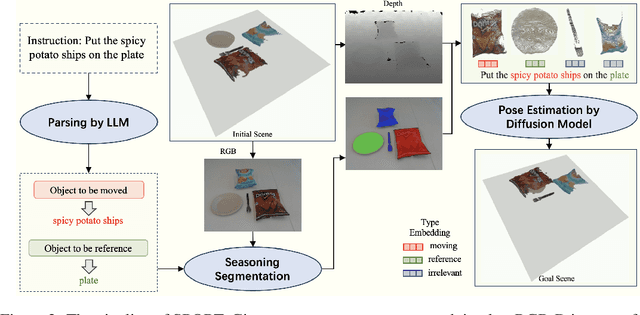

General-purpose object placement is a fundamental capability of an intelligent generalist robot, i.e., being capable of rearranging objects following human instructions even in novel environments. To achieve this, we break the rearrangement down into three parts, including object localization, goal imagination and robot control, and propose a framework named SPORT. SPORT leverages pre-trained large vision models for broad semantic reasoning about objects, and learns a diffusion-based 3D pose estimator to ensure physically-realistic results. Only object types (to be moved or reference) are communicated between these two parts, which brings two benefits. One is that we can fully leverage the powerful ability of open-set object localization and recognition since no specific fine-tuning is needed for robotic scenarios. Furthermore, the diffusion-based estimator only need to "imagine" the poses of the moving and reference objects after the placement, while no necessity for their semantic information. Thus the training burden is greatly reduced and no massive training is required. The training data for goal pose estimation is collected in simulation and annotated with GPT-4. A set of simulation and real-world experiments demonstrate the potential of our approach to accomplish general-purpose object rearrangement, placing various objects following precise instructions.